Myanmar is one of those rare places where shopping feels less like a transaction and more like stepping into a living craft tradition. Unlike the mass-produced tourist trinkets you'll find across Southeast Asia, Myanmar's market stalls and workshops are still stocked with goods made the way they've been made for centuries, lacquerware shaped by hand on wooden molds, silk longyi woven on traditional looms, jade carved into jewelry that carries the country's most storied export. From Bagan's ancient lacquerware workshops to the floating markets of Inle Lake, the craftsmanship here is genuine, the variety remarkable, and the prices, for now, still reasonable for quality that would cost far more elsewhere.
This guide covers the best Myanmar souvenirs worth buying, where to shop for them, practical tips to help you shop smart, and quick answers to the questions most travelers ask before they leave.
Best Myanmar Souvenirs to Buy
1. Lacquerware (Yun-De)
Lacquerware is Myanmar's most iconic craft, and Bagan is its spiritual home. The tradition stretches back over a thousand years, when artisans began coating woven bamboo frames with layers of thitsi, a natural lacquer derived from a local tree sap, and hand-painting intricate motifs in gold, red, and black.
Today's lacquerware comes in bowls, trays, jewelry boxes, tea sets, and decorative plates. The quality varies enormously. Budget pieces at 3,000–10,000 MMK (roughly $1–$5 USD) are typically painted over a bamboo frame and finished quickly. Premium pieces, the ones worth buying, use a horsehair or teak-and-bamboo mixed frame, go through five to ten layers of lacquer with drying time between each, and are etched with fine detailing by hand. Those start around $20–$50 USD and go up significantly for antique-quality work.
The best place to buy authentic lacquerware is directly from workshops in Bagan's Myinkaba village, where you can watch the process and verify the quality before purchasing.
2. Longyi (Traditional Wraparound Cloth)
The longyi is Myanmar's national garment, a large rectangle of fabric wrapped and tucked at the waist, worn daily by men and women of every age. It's one of the most practical and culturally meaningful things you can bring home, and unlike many souvenirs, it's something you'll actually use.
Women's longyi (htamein) typically feature bright colors and vertical or diagonal patterns. Men's versions (paso) are generally plaid or checkered and tied with a flat front knot. Cotton longyi are light, breathable, and ideal for travelers, prices run from $3–$10 USD for everyday cotton in local markets. Silk longyi, especially those woven in Inle Lake's famous lotus silk, are far more luxurious and priced accordingly at $30–$100 USD or more for handwoven pieces.
Bogyoke Aung San Market in Yangon has an excellent longyi selection across all price points, as do the textile stalls around Mandalay's Zegyo Market.
3. Jade and Precious Gemstones
Myanmar supplies an estimated 90 percent of the world's gem-quality jade, along with significant quantities of rubies, sapphires, and spinel. If you're interested in gemstones, there is simply no better place in the world to be shopping.
That said, the jade market requires some homework. You'll find everything from museum-quality imperial green jadeite to dyed, treated, and outright fake pieces sold alongside it. Loose stones allow you to evaluate quality more clearly than finished jewelry, where settings can conceal flaws. For meaningful purchases, stick to reputable dealers at established markets like Bogyoke or Mandalay's dedicated Jade Market, ask for any available certification, and understand that truly fine jade is not cheap, if the price seems impossibly low, the stone is not what it appears to be.
Ruby and sapphire jewelry is also widely available at more accessible price points, and pieces set in silver make excellent travel-sized gifts.
4. Thanaka Powder and Cosmetics
Thanaka is one of the most visually distinctive things about Myanmar, the pale yellow-white paste that women (and many children) apply to their cheeks and foreheads in decorative swirls and leaf patterns. Made from the ground bark of the thanaka tree, it has been used for over two thousand years as a natural sunscreen, skin smoother, and fragrance.
For travelers, thanaka makes an ideal souvenir: compact, lightweight, genuinely unique to Myanmar, and cosmetically useful. You'll find it sold as sticks of raw bark (which you grind yourself on a flat stone with a small amount of water), as ready-mixed pastes, and in modern cosmetic formats, creams, face masks, and cleansers marketed to international buyers. Raw bark sticks cost under $1 USD and are available in almost every market. Packaged cosmetic versions are slightly pricier but easier to transport.
5. Handwoven Textiles and Tapestries (Kalaga)
Kalaga are elaborately embroidered tapestries that originated in Mandalay during the royal court era. Traditionally made to decorate palace walls and ceremonial spaces, they depict scenes from Buddhist mythology, the Jataka tales, and classical court life using a distinctive three-dimensional technique: sequins, glass beads, colored thread, and padded velvet stitched onto a black or dark background to create raised figures that seem almost sculptural.
Full-sized kalaga make dramatic wall hangings and are among the most impressive craft pieces you can take home from Myanmar. Prices for large, high-quality pieces with fine detailed work start around $50–$100 USD and rise into the hundreds for antique or museum-grade examples. Smaller kalaga panels, pillowcases, and framed pieces are available at more accessible prices in Mandalay's markets and at craft shops throughout Bagan and Yangon.
6. Traditional Puppets (Yama Zatpwe Marionettes)
Yama zatpwe, Myanmar's classical marionette theater, features elaborately costumed puppets with multiple articulated joints that allow skilled performers to replicate the movements of human dancers with remarkable precision. The tradition is recognized as one of Myanmar's most refined art forms, and the puppets themselves are extraordinary objects even when not in performance.
Today's craft puppets for the souvenir market range from simple decorative figures at around $5–$10 USD to highly detailed performance-quality marionettes with silk costumes, real hair, and fine lacquered faces that sell for $50–$200 USD or more. Common character types include the prince, the princess, the court fool, the ogre, and the celestial horse. They're available at markets throughout Mandalay and Bagan, with the most detailed work found in Mandalay's dedicated craft shops along 78th Street.
7. Myanmar Tea and Local Food Items
Myanmar's food culture offers several shelf-stable souvenirs that are genuinely difficult to find outside the country.
Lahpet, fermented tea leaves, is perhaps the most culturally specific. Eaten rather than brewed, it's the base of lahpet thoke, a tangy, textured salad that is considered something close to a national dish. Packaged lahpet for export is available at Yangon's supermarkets and specialty food shops, often packed with the traditional accompaniments of fried garlic, sesame seeds, and dried shrimp.
Beyond lahpet, look for high-quality green teas from Shan State, sold loose-leaf at markets for $2–$8 USD per bag. Tamarind candy, sweet, sour, and slightly chewy, is inexpensive, shelf-stable, and universally liked. Shan-style coffee from the hills around Kalaw is another sleeper pick, milder than Vietnamese or Thai styles and aromatic in a way that doesn't require condensed milk to be enjoyable.
Read Related Article: Best Things to Buy in Malaysia: Malaysian Souvenirs and Must-Buy Items
Discover the best things to buy in Malaysia, from traditional batik and handcrafted souvenirs to local snacks, tea, and unique cultural treasures. Find must-buy Malaysian gifts and authentic keepsakes to bring home from your trip.
Read More
4 Best Places to Shop for Myanmar Souvenirs
1. Bogyoke Aung San Market, Yangon
If you only have time for one shopping stop in Myanmar, make it Bogyoke. Built in 1926 during the British colonial era and originally named Scott Market after Municipal Commissioner Gavin Scott, this sprawling red-brick complex is home to over 1,600 stalls, and it remains the single most concentrated source of authentic Myanmar crafts under one roof anywhere in the country.
You'll find gemstones, jade, Burmese rubies, sapphires, pearls, handwoven longyi, lacquerware, kalaga tapestries, puppets, antiques, wood carvings, and traditional clothing, all within walkable distance of each other. The covered colonial walkways mean you can browse comfortably even in the midday heat, and the mix of long-established boutiques alongside smaller vendor stalls gives you a real spread of quality and price points. There's also a small food court and stalls selling avocado and orange juice, a worthwhile stop once the heat gets to you.
What makes it worth your time over other markets: Bogyoke is the only place in Myanmar where gem dealers, textile vendors, and certified silversmiths all operate in the same compound. Several shops here have on-site laboratories that can authenticate your purchases, a service you won't find at smaller markets. If you're buying gemstones, look for shops affiliated with the Myanmar Gems Enterprise and always ask for a government-issued purchase voucher (a printed receipt that doubles as a customs declaration document). Without it, raw stones can be confiscated at the airport.
Honest heads-up: A portion of vendors here do overcharge tourists, and some guides who "offer to show you around" are earning a commission from shops they bring you to. The fix is simple: walk in on your own, browse widely before committing to anything, and treat the first price quoted as a starting point rather than the final one. Opening prices for jade and gems in particular can be two to three times the realistic selling price. For longyi, a good cotton piece runs around 15,000–25,000 MMK ($7–$12 USD); a silk longyi starts around 50,000 MMK ($24 USD) and goes up significantly for quality weaves.
Best time to visit: Arrive after 3:00 PM when new stock arrives and vendors are more motivated to sell. The market is open Tuesday through Sunday, 9:30 AM to 5:00 PM, closed Mondays and public holidays. Entry is free.
Practical note: Junction City Mall is directly across the street, air-conditioned, with ATMs and a food court, useful if you need a break or a cash top-up mid-shop.
2. Mahar Aung Myay Jade Market, Mandalay
This is not a tourist attraction that happens to sell jade. It is a working wholesale trading floor where merchants, cutters, polishers, and buyers, many of them Chinese traders using mounted smartphones to livestream stones back to buyers overseas, conduct real business every morning. That distinction matters: the Mandalay Jade Market is worth visiting primarily as an experience, and secondarily as a place to buy.
Myanmar produces roughly 70 percent of the world's jadeite, the rarer, more valuable variety of jade, and a significant share of that supply passes through this market on its way to buyers across Asia. Walking the narrow grid of stalls on 87th Street and into Hparkant Mall on 86th Street, you'll see stones in every stage: raw boulders being assessed under torchlight, rough pieces being cut by hand-held rotary saws, finished cabochons being sorted by color and clarity, and finished jewelry displayed in glass cases. The contrast between old-school haggling over cigarettes and tea and younger traders livestreaming on smartphones is genuinely something you won't see anywhere else.
What sets it apart: Unlike any gem market in the region, this one lets you observe the full supply chain, from rough stone to finished piece, in a single visit. The Unison Teahouse inside the market is a good spot to sit, watch the negotiations, and get a sense of how jade trading actually works before you consider buying anything.
Buying here: The market is more suited to experienced buyers than casual tourists. Finished jewelry (rings, bangles, pendants) from reputable stalls within the main market is the safest purchase, get an itemized receipt for customs. Raw jade is legally more complicated: it can be sold without documentation, but customs at Mandalay airport may confiscate undocumented raw stones on departure. Stick to finished pieces and insist on a receipt. Small jade items, carved pendants, simple bangles, start from around 5,000–15,000 MMK ($2.50–$7 USD). Quality jadeite rings from established stalls typically start at 50,000–200,000 MMK ($24–$95 USD) and go well beyond that for fine-grade pieces.
When to go: Early morning is when the market is most active and most worth seeing, the main trading action winds down by midday. There is a small entrance fee of approximately 2,500 MMK (~$1.20 USD) for the main trading section in the morning hours; entry is generally free in the afternoon, when foot traffic drops significantly. Enter from 87th Street.
3. Inle Lake, Floating Markets and Weaving Villages
Inle Lake is Myanmar's most atmospheric shopping destination, and it's the only place in the world where you can buy lotus silk, one of the rarest fabrics on earth, directly from the village where it's made.
The lake operates on a five-day rotating market system, where the floating market moves between different villages on a cycle, ensuring the commercial activity benefits communities across the lake rather than concentrating in one spot. The market that arrives at your nearest village during your stay is worth the boat ride: vendors sell everything from silver jewelry and hand-painted Shan umbrellas to lacquerware, cheroot cigars, and locally grown tea, with prices that are generally lower than Yangon.
The lotus silk workshop visit is the unmissable stop: In the floating village of Inn Paw Khon, a cluster of weaving cooperatives produce cloth woven entirely from lotus fiber, a process that has been practiced here for over a century and is now almost exclusively found at Inle Lake. A single scarf requires stems from roughly 20,000 lotus plants and takes weeks to produce, which explains why lotus fabric retails for $200–$300 USD for a scarf and up to $6,000 USD for a suit length. You'll watch artisans break and twist individual lotus stems by hand to extract the filament, spin it on small frames, and weave it into the softest, most unusual cloth you've likely ever held.
If that's out of your budget, the workshops at Khit Sunn Yin Lotus, Silk and Cotton Hand Weaving Centre (Paw Khon Village) and Ko Than Hlaing Weaving also produce silk and cotton longyi and scarves at far more accessible prices, cotton scarves from around 8,000–15,000 MMK ($4–$7 USD), silk pieces starting around 30,000 MMK ($14 USD). Buying directly from the cooperative means your money goes to the artisans, not a middleman.
Other things worth buying at Inle Lake: Handmade Shan paper umbrellas (beautiful as decoration, light to carry, 5,000–20,000 MMK / $2.50–$10 USD), silver jewelry from the lake's silversmith workshops, and hand-dyed silks from the weaving villages of Kyaing Khan.
Practical note: All shopping at Inle Lake is done by boat. Arrange a full-day boat tour through your guesthouse in Nyaungshwe, the standard tour includes weaving village stops, and book directly rather than through a hotel booking desk to get the better rate. Bring more cash than you expect to need; there are no ATMs on the lake itself.
4. Mandalay Market, North Dagon (Local Wet Market)
This one is for a different kind of traveler, someone who wants to see how Myanmar actually shops, not how it presents itself to tourists.
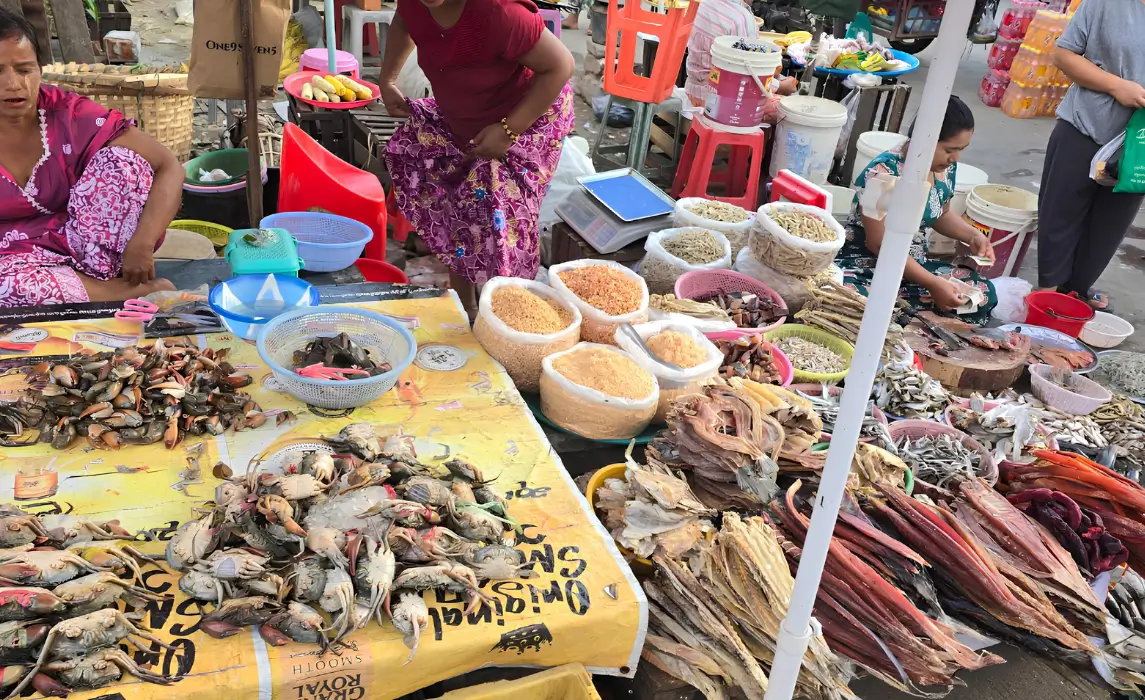
The North Dagon Mandalay Market is a dense, loud, genuinely local wet bazaar that operates across morning and evening sessions. It's not curated, there are no English-language price tags, and no one is particularly interested in selling to you over the local customer standing next to you. That's precisely what makes it valuable. Prices here are fairer than anywhere else on this list, and the evening market especially has an energy, hawker stalls, food vendors, and produce sellers setting up as the sun drops, that gives you an honest, unfiltered picture of daily commercial life in Myanmar.
What to buy here: The market is not a handicraft destination, but it's excellent for edible souvenirs and everyday items. Look for packaged Shan tea, local spices, tamarind candy, lahpet (fermented tea leaves sold loose by weight), and dried goods to take home. These typically run 2,000–8,000 MMK ($1–$4 USD) per bag and are significantly cheaper than packaged versions sold at tourist markets. If you're a photographer, the morning fish and produce market is striking, with vendors arranging fresh catch and vegetables in a way that's entirely unselfconscious.
What to skip: This is not the place for lacquerware, jade, textiles, or souvenirs that require quality verification. It's a daily essentials market, and its strength is exactly that.
When to go: The evening session starting around 4:00–6:00 PM is the most active and atmospheric. Morning from 6:00–9:00 AM is best for fresh produce and fish. Expect traffic congestion in the 4–6 PM window, arrive by foot or motorbike taxi if you can. No entrance fee.
Read Related Article: Best Supermarkets in Japan | Your Guide to Top Japanese Grocery Stores
Discover the best supermarkets in Japan, from popular grocery chains to specialty food markets. Learn where to shop for fresh produce, Japanese snacks, bento meals, and authentic local ingredients across the country.
Read More
Shopping Tips for Myanmar
1. Bargaining Etiquette, When It's Expected, When It's Not
Bargaining is standard practice at open-air markets, roadside stalls, and most informal shops throughout Myanmar. Starting at 50–60 percent of the asking price and working toward a middle ground is generally accepted and expected. Maintain a pleasant, unhurried tone, aggressive bargaining is considered rude, and walking away while negotiating can be effective but should always be done politely.
Fixed-price shops (often signposted as such) and larger craft emporiums like Bogyoke's more established boutiques generally do not negotiate. At government-run shops and certified craft centers, prices are set. Use the fixed-price benchmark to calibrate what's reasonable at market stalls selling the same category of goods.
2. Spotting Authentic vs. Mass-Produced Items
For lacquerware, the scratch test is widely cited: run your fingernail lightly along the interior, quality lacquer will not scratch easily, while cheap painted pieces chip or flake. Bend a flexible lacquerware bowl gently, good-quality horsehair pieces spring back; bamboo pieces may stay deformed. Authentic pieces are also noticeably heavier than their thin-frame imitations.
For jade, the safest approach is to buy from established dealers and request documentation. Avoid street vendors offering deep discounts on large pieces. Real jadeite is cold to the touch and has a glassy, translucent appearance; treated or dyed stones often have an unnatural uniformity of color. If you're spending significant money, consider consulting a certified gemologist or buying from a shop affiliated with a gemological authority.
3. Currency and Payment
Myanmar's official currency is the kyat (MMK). Most market transactions are cash-only in kyat, and prices at local markets are quoted and expected to be paid in local currency. USD is widely accepted at larger hotels, tourist-oriented shops, and some gem dealers, but bills must be clean, unfolded, and in good condition; damaged notes are routinely refused.
Credit and debit cards are accepted at some upscale shops in Yangon and at major hotels, but card infrastructure is limited and unreliable outside the city. Bring more cash than you think you'll need before heading to Bagan, Inle Lake, or Mandalay, and exchange currency at banks or licensed money changers rather than informal exchange desks.
4. What NOT to Buy
Avoid purchasing items made from ivory, tortoiseshell, or animal products, these are illegal to export from Myanmar and illegal to import into most countries. Certain antiques over 100 years old are protected under Myanmar law and cannot be exported without a government permit that is rarely granted to tourists; buying them puts you at legal risk.
Exercise caution with any seller claiming a religious artifact has specific spiritual power or that a gemstone is "government certified" without documentation to prove it. Cultural sensitivity also applies to purchasing items used in active religious practice, Buddha images, for example, are revered objects and importing them is restricted or outright banned in several countries.
5. Packing and Customs
Lacquerware, while more durable than it looks, should be wrapped carefully for travel. Nesting pieces inside soft clothing works well; avoid hard-sided compression. Breakage from improper packing voids any return possibility, and few sellers offer after-sale support.
Gemstones and jewelry should be declared at customs on departure from Myanmar and again on arrival in your home country. Undeclared gems can be confiscated. Keep receipts from reputable dealers, as these can support your declaration and help establish value. For most other souvenir purchases, longyi, lacquerware, puppets, food items, standard customs rules for your home country apply, and declaration is generally required only above a personal exemption threshold.
Read Related Article: Beijing Shopping Guide: Best Places to Shop
Explore the best shopping in Beijing, from bustling markets and luxury malls to traditional shopping streets and local boutiques. Discover top places to shop for fashion, souvenirs, electronics, and authentic Chinese goods.
Read More
Frequently Asked Questions
1. What is the most popular souvenir from Myanmar?
Lacquerware and longyi are consistently the top picks among travelers. Both are widely available across Myanmar's main tourist destinations, reasonably priced across multiple quality tiers, and culturally significant in a way that gives them meaning beyond decoration. Lacquerware travels well and is distinctive enough that most people back home won't have seen anything like it. A quality silk longyi, meanwhile, is a wearable souvenir that gets used rather than displayed on a shelf.
2. Is it safe to buy jade in Myanmar?
Yes, but with important caveats. The jade market has a long history of sophisticated imitation and treatment methods that are invisible to the untrained eye. For small, low-cost jade items, simple bangles, pendants, or carved figures, the risk is minimal. For significant purchases, buy only from established dealers at reputable markets, ask for any available gemological documentation, and avoid bargain pricing on pieces being presented as high-quality jadeite. If you're genuinely interested in investing in jade, consider connecting with a certified dealer through a hotel concierge or tour operator who can vet the source.
3. Can I bring Myanmar souvenirs through customs?
Most standard souvenirs, lacquerware, longyi, thanaka, puppets, packaged food items, pass through customs without issue. The items that require attention are gemstones (declare them and keep receipts), antiques (avoid anything over 100 years old without export documentation), and any products made from protected animal materials, which are prohibited entirely. Myanmar's customs authority requires an export permit for antiques, and your home country's import rules apply on arrival. When in doubt, declare rather than conceal, undeclared goods are subject to confiscation, and declared goods are rarely problematic if purchased legitimately.
{ "@context": "https://schema.org", "@type": "Article", "mainEntityOfPage": { "@type": "WebPage", "@id": "" }, "headline": "Myanmar Souvenir: 10 Burmese Gifts You'll Want to Own", "image": [], "datePublished": "", "dateModified": "", "author": { "@type": "Person", "name": "" }, "publisher": { "@type": "Organization", "name": "", "logo": { "@type": "ImageObject", "url": "" } }, "description": "Discover 10 must-have Myanmar souvenirs! From exquisite lacquerware to unique crafts, find the perfect Burmese gifts you'll cherish forever." }

.webp)
.webp)
.webp)
.webp)
%2520(1).webp)
.webp)
.webp)
.webp)
.webp)
.webp)
.webp)
.webp)
.webp)
.webp)
.webp)
.webp)
.webp)
.webp)
.webp)
.webp)
.webp)
.webp)
.webp)
.webp)
.webp)
.webp)
.webp)
.webp)
.webp)
.webp)
.webp)