Read Related Article: Best Mongolian Souvenirs to Buy & Bring Back from Mongolia
Discover the best Mongolian souvenirs to buy, from handmade cashmere and traditional crafts to unique cultural keepsakes that capture the spirit of Mongolia.
Read More
.webp)
Hawaii, a tropical paradise located in the Central Pacific, is renowned for its breathtaking natural beauty, including pristine beaches, lush rainforests, and dramatic volcanic landscapes. Comprising a chain of islands, each with its own distinct character, Hawaii offers a diverse range of experiences for visitors. The island of Oahu is home to the vibrant city of Honolulu and the historic Pearl Harbor, while Maui boasts stunning beaches and the scenic Hana Highway. The Big Island, known as Hawaii Island, features active volcanoes in Hawaii Volcanoes National Park and majestic waterfalls along the Hamakua Coast. Kauai, often called the "Garden Isle," enchants visitors with its verdant valleys and towering sea cliffs. With its unique blend of Polynesian culture, warm hospitality, and natural wonders, Hawaii offers an unforgettable escape for travelers seeking paradise.
.webp)
.webp)
.webp)
%2520(1).webp)
.webp)
.webp)
.webp)
.webp)
.webp)
.webp)
Nevada, located in the western United States, is renowned for its diverse landscapes, vibrant entertainment, and rich history. The state is most famous for Las Vegas, a global entertainment capital known for its bustling casinos, world-class shows, and vibrant nightlife. Beyond the glitz of Las Vegas, Nevada offers stunning natural beauty, including the rugged terrain of the Mojave Desert, the alpine scenery of Lake Tahoe, and the striking rock formations of Red Rock Canyon and Valley of Fire State Park. The state capital, Carson City, along with historic towns like Virginia City, reflect Nevada's storied past rooted in the mining boom of the 19th century. With its blend of high-energy urban centers, expansive deserts, and scenic mountains, Nevada provides a unique and captivating experience for residents and visitors alike.
.webp)
.webp)
.webp)
.webp)
.webp)
.webp)
.webp)
.webp)
.webp)
.webp)
Florida, situated in the southeastern United States, is renowned for its sunny weather, sandy beaches, and vibrant culture. The state is home to world-famous tourist destinations like Walt Disney World Resort in Orlando, the Everglades National Park, and the vibrant art deco architecture of Miami Beach. With its diverse population, Florida boasts a rich cultural tapestry influenced by Latin American, Caribbean, and Southern traditions. Its economy is driven by industries such as tourism, agriculture, aerospace, and technology. Florida's natural beauty, outdoor recreational opportunities, and lively entertainment scene make it a popular destination for residents and visitors seeking fun in the sun.
.webp)
.webp)
.webp)
.webp)
.webp)
.webp)
.webp)
.webp)
.webp)
.webp)
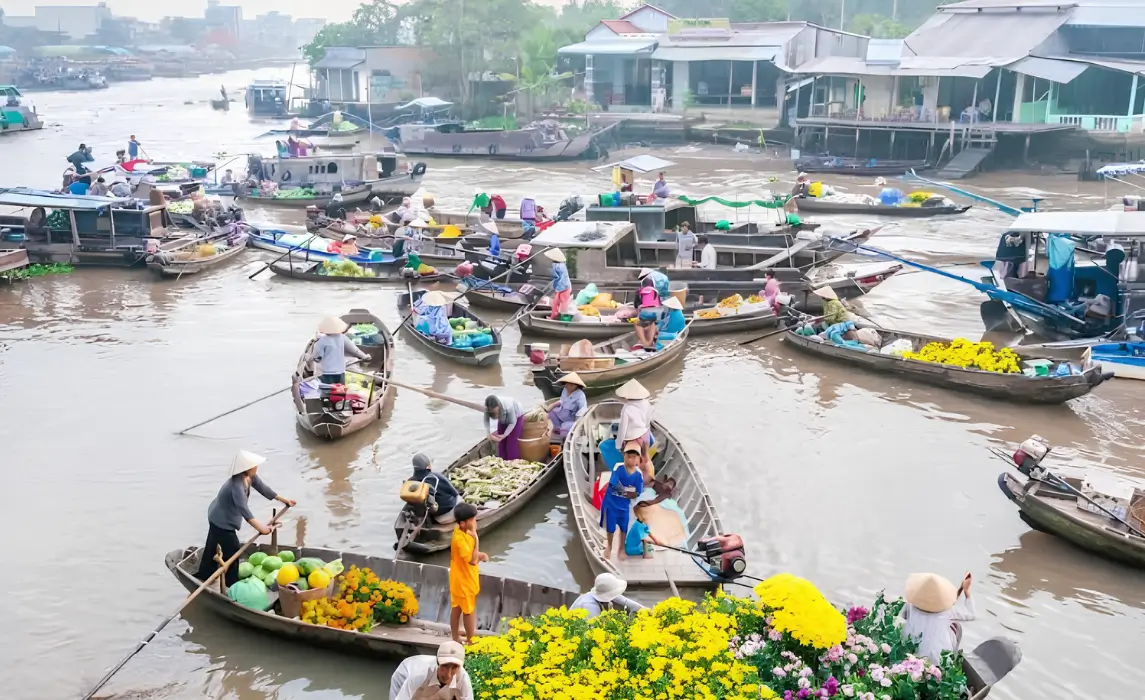
Picture postcards of the Mekong Delta almost always show the same scene: a river crowded with wooden boats, mountains of dragon fruit and durian stacked on deck, someone's grandmother passing over a steaming bowl of noodle soup before the sun has even cleared the horizon. That scene is real, but it's no longer guaranteed, and it doesn't look the same at every market.
Vietnam's floating markets grew out of necessity. Before roads reached deep into the Delta, the river was the road, and farmers sold directly from boat to boat because there was no other way to move goods. As bridges and highways expanded over the last two decades, that necessity disappeared, and so did much of the trade.
This guide is built from recent, on-the-water visitor accounts rather than outdated tourism-board descriptions, so you know exactly what's still operating, what time to show up, what it actually costs, and which market matches the experience you're after, whether that's a lively photo-worthy market or a quiet sunrise float with a bowl of pho.
Cai Rang remains the headline floating market of the Mekong Delta, and for good reason, it's the only one still operating at a scale large enough to feel like an actual market rather than a few stray boats. The trading zone has shrunk considerably, down from roughly a kilometer of boats to about 200 meters today, and a good portion of what's left is wholesale activity between traders rather than vendors selling directly to visitors. That distinction matters: you're watching commerce happen, not a staged show for tourists, which is part of what makes it interesting.
What sets Cai Rang apart from every other market on this list is the cây bẹo, a tall bamboo pole mounted on the bow of each boat with a sample of whatever's for sale (a pineapple, a bundle of squash, a cabbage) hung at the top, so buyers can spot a boat's inventory from a distance without shouting across the water. It's a centuries-old visual catalog system unique to Mekong Delta floating markets, and Cai Rang has the highest concentration of boats still using it.
Getting there and cost: Boats leave from Can Tho's main wharf. A shared boat runs ₫100,000–500,000 per person (roughly $4–19), while a private boat for up to three hours costs around ₫700,000 (about $27) total, regardless of group size. Arrive between 5:30 and 7:00 AM, any later and the wholesale boats have already cleared out for the day.
One thing worth knowing before you book: river sanitation is a real and recurring complaint here, with household and boat waste visibly entering the water near the market. It doesn't ruin the visit for most people, but it's worth setting expectations rather than discovering it on arrival.
.webp)
Discover the best Mongolian souvenirs to buy, from handmade cashmere and traditional crafts to unique cultural keepsakes that capture the spirit of Mongolia.
Read MoreNga Bay carries serious historical weight, it's been trading at the junction of seven canals since 1915, making it one of the oldest commercial sites in the Delta. That history is the main reason to visit, because the floating side of it has largely disappeared. River-based boat trading here was officially disbanded in 2016, and what remains is primarily a land market at the canal intersection, with only occasional boats still on the water.
What still makes Nga Bay worth a stop, if you're already in the area, is the architecture of the seven-canal junction itself, a unique geographic feature where waterways from seven directions converge, something no other market on this list can offer. It's a striking sight even without boats on it, and it explains why this exact spot became a trading hub in the first place over a century ago.
Getting there and cost: Most visitors combine Nga Bay with a Can Tho or Cai Rang itinerary rather than visiting it alone, since boat tour pricing is bundled similarly, expect ₫100,000–500,000 per person (about $4–19) for a shared boat. Go early morning if you want any chance of boat activity; by mid-morning, it's a land market only.
Set expectations before booking: visitor reports describe it as more crowded and slightly more expensive for food than its land-market equivalents nearby. If your priority is seeing boats on water, this isn't the strongest choice in 2026, treat it as a historical stop, not a floating-market experience.
If Cai Rang is the market for the postcard photo, Phong Dien is the market for actually seeing how Delta life still runs. It's a retail market, not wholesale, meaning the roughly 20 boats here are selling food and produce directly to other locals, day to day, with tourism as a side effect rather than the point. Visitors who've done both markets consistently describe Phong Dien as the more authentic of the two.
What makes it genuinely distinct is its operating rhythm: Phong Dien opens and closes earlier than Cai Rang, often winding down by mid-morning, which means a 3:30–5:00 AM start isn't unusual for visitors chasing the market at full activity. That earlier, shorter window, combined with a far lower tourist boat count, is exactly why the atmosphere here still feels unscripted.
Getting there and cost: By boat from Can Tho, plan on roughly two hours each way; by road, it's under 30 minutes, making a hybrid trip (drive to the riverside, then hire a local boat) a practical option. Boat hire here is typically negotiated directly with the boatman at the dock rather than fixed-rate, so confirm the price before boarding, expect a range similar to Cai Rang's shared-boat pricing, around ₫100,000–500,000 per person ($4–19).
A popular and time-efficient option: stay at one of the homestays located between Cai Rang and Phong Dien, which lets you visit both markets in a single early-morning outing rather than choosing one over the other.
Of every market in this guide, Ca Mau has moved furthest from its floating roots. What's on the Ganh Hao River today is a small remnant, a handful of boats, sometimes none, while the real action has shifted to a bustling shore-based market right at the riverbank. If you go in expecting a floating market, you'll likely leave disappointed; if you go in expecting a busy provincial river market with boats arriving at night to unload, it's actually a solid stop.
What's unique to Ca Mau, and worth knowing in advance, is its overnight delivery cycle: goods arrive by boat between roughly 2:00 and 3:00 AM, well before most tourists are awake, so the freshest activity on the water happens at an hour almost no visitor itinerary covers. By the time a typical 5:30 AM tourist boat arrives, that overnight unloading is already done.
Getting there and cost: The market sits in Ward 8 of Ca Mau city, about 200 meters from Ganh Hao Bridge, easy to reach on foot or by taxi, with no boat tour necessary unless you specifically want to be on the water. The shore market runs all day, roughly 5:00 AM to 8:00 PM, so there's no need for an extreme early start unless you're chasing that 2–3 AM delivery window.
The one consistent and serious complaint here is sanitation, multiple visitors describe garbage and waste along the riverbank and a strong odor near the water. Locals are uniformly described as warm and easygoing, but the environmental state of the riverside is a real factor in deciding whether this stop is worth your time.
Discover the best things to buy in Malaysia, from delicious local snacks and batik fabrics to handcrafted souvenirs and unique Malaysian gifts.
Read MoreLong Xuyen is the market in the middle, still technically operating daily, but with a fraction of the boats it once had. It runs along roughly 2 kilometers of the Hau River near the O Moi ferry terminal, officially from 5:00 AM to 10:30 AM, with the 5:00–7:00 AM window being the only realistic time to catch any meaningful boat activity. Recent visitors describe arriving to find just a handful of vendors selling coffee and noodle soup, a noticeable drop from what guidebooks still promise.
What makes Long Xuyen worth the trip anyway, if you reframe your expectations, is what it offers that busier markets can't: a genuinely peaceful, near-empty river at dawn. Several visitors specifically describe it as a better sunrise boat ride than a shopping experience, drifting in near-silence as the sky lightens, with just enough activity (a coffee boat, a noodle vendor) to make it feel lived-in rather than abandoned. It's the most contemplative version of a Mekong floating market currently available, and it pairs well with a visit to Long Xuyen's shore market or nearby orchards afterward.
Getting there and cost: Boats depart near Hoang Dieu Bridge or the O Moi Ferry Terminal in Long Xuyen city. Pricing is typically a flat rate of around ₫500,000 per boat (about $19), regardless of how many people are aboard, so it's most cost-effective with two or more people splitting the fare. Avoid visiting on the first day of the lunar month if possible; several visitors note unusually low boat turnout on that specific day.
Currency conversions calculated at approximately ₫26,400 = $1 USD. Rates fluctuate, so check a live converter before your trip.
Cai Rang and Phong Dien still deliver a real floating-market experience and are worth the early start. Nga Bay and Ca Mau have largely shifted ashore, so treat those as land-market stops rather than floating markets. Long Xuyen sits in between, go for the quiet sunrise, not for crowds of boats.
Plan for 5:00–7:00 AM at most markets. Phong Dien can start as early as 3:30 AM, while Ca Mau's only real boat activity happens overnight, between 2:00 and 3:00 AM.
Shared boats generally run ₫100,000–500,000 per person (about $4–19). Private boats for a few hours cost roughly ₫500,000–700,000 total ($19–27), regardless of group size, splitting that with travel companions brings the per-person cost down significantly.