Beijing doesn't do shopping in half measures. Within a single afternoon, you can bargain down a silk scarf at a centuries-old market, browse a luxury department store that outsells Harrods on annual revenue, then grab skewered street food on your way to the metro. Every neighborhood has its own tier of retail, and knowing which area serves which purpose will save you real time, and real money.
This guide focuses on the three shopping districts that matter most, the three markets worth your morning, what to actually put in your bag, and how to bargain without getting taken.
Shopping Districts
Wangfujing (王府井)
Wangfujing is Beijing's most famous shopping street, and it earns that title more through history and infrastructure than any single standout experience. The name translates to "Well of the Prince's Mansion," a nod to the Ming Dynasty estates that once lined this stretch of Dongcheng District. Today it's a fully pedestrianized corridor running roughly 800 meters, no cars, no bikes, and on a weekend evening, barely room to breathe.
What makes it genuinely useful is the variety packed into a walkable strip. The Beijing Department Store (百货大楼), open since 1955, anchors the south end with silk scarves (¥80–200 / ~$11–$28), tea sets, and cloisonné ware at prices that don't require bargaining. The Beijing APM Mall carries the only three-story Apple Store in Asia alongside K-beauty counters and international fast fashion. For higher-end brands, Gucci, Saint Laurent, WF Central sits tucked behind quiet courtyard architecture nearby, designed deliberately to slow you down from the main street's pace.
The Snack Street (王府井小吃街) branching off the main strip is the most photographed part: vendors selling Peking yogurt, lamb skewers, and the scorpion-on-a-stick that every travel photo features. Most snacks run ¥10–35 ($1.40–$5). The scorpions are alive until cooked, it's a tourist novelty, not a traditional Beijing food, so go in with that framing. For a real meal, Quanjude on Wangfujing has served roast duck since 1864; budget ¥150–250 ($21–$35) per person. One honest note: Wangfujing can feel caught between worlds, it's lost some historical character without fully matching the modern edge of Sanlitun or Guomao. It's worth visiting, especially at night when the neon hits the old facades, but it shouldn't be your only stop.
Get there: Metro Line 1 or 8 to Wangfujing Station. Weekday mornings are noticeably calmer.
Sanlitun (三里屯)
If Wangfujing is Beijing's most recognized shopping street, Sanlitun is where Beijing actually wants to be seen. Originally the embassy quarter and nightlife hub, it has evolved over two decades into the most internationally charged district in the capital, a place where expats, local fashion editors, and first-time tourists all occupy the same open-air plaza without any one group dominating it.
The heart of the district is Sanlitun Taikoo Li (太古里), an open-air complex of glass-and-stone that splits into a north and south section. The Apple Store here was Asia-Pacific's largest when it opened in 2020. Beyond that, you'll find Nike flagship, Adidas, Lululemon, Uniqlo's biggest Beijing outpost, and enough emerging Chinese streetwear labels, Bosie, SMFK, Attempt, to fill a full afternoon if that's your direction. Prices in branded stores are fixed and globally comparable: Nike Air Max runs ¥1,099–1,599 (~$152–$221), Uniqlo basics ¥99–299 (~$14–$41). The north section of Taikoo Li runs quieter and more curated, worth exploring once the south section crowd gets overwhelming.
What sets Sanlitun apart from every other district is that it functions as much as a leisure destination as a retail one. Terraces fill up by early evening, bars activate after 8pm, and the mood shifts meaningfully between a Sunday afternoon browse and a Thursday night out. The Sanlitun SOHO complex across the road hosts an "I'm in Beijing" photo landmark that's become a genuine local institution. The crowd here skews younger and more fashion-forward than Guomao, and the energy is more international than Xidan, it's the district that makes the best argument for Beijing as a genuinely global shopping city.
Get there: Metro Line 10 to Tuanjiehu, Exit A.
Qianmen Street (前门大街)
Qianmen is one of the rare shopping areas that actually lives up to its historical framing. Running from the grand Zhengyang Gate southward along the city's central axis, this was once the imperial ceremonial route, and unlike Wangfujing, which shed most of its historical character in the push toward modernity, Qianmen retained the grey brick façades and Ming-Qing dynasty architectural silhouette even as the interiors were rebuilt.
Walking it today, you'll find the kind of mix that's increasingly hard to find in Beijing: established Chinese heritage brands operating exactly where they always have. Neiliansheng (内联升), the cloth shoe maker that has been on this street since 1853, still sells hand-stitched shoes using the same construction method used for the Qing court, prices start at ¥200–600 (~$28–$83) depending on design. Ruifuxiang (瑞蚨祥) has supplied silk to Chinese families since the 1890s; a bolt of fabric or a silk qipao here is one of the more meaningful purchases you can make in the city. Wuyutai (吴裕泰), the jasmine tea brand that old Beijingers consider simply part of daily life, has a flagship here where loose leaf starts around ¥50–300 (~$7–$41) per 100g. These are not tourist approximations of old Beijing culture; they are old Beijing culture, still operating.
The Dashilan alley (大栅栏, pronounced "Dashilar") branches west off the main street into a more chaotic, more local stretch of narrow storefronts and hutong lanes worth exploring on foot. Qianmen's best quality, though, is the evening. When the traditional buildings light up, the atmosphere becomes genuinely cinematic, families walking, street performers along the edges, the pace dropping compared to the daytime tourist flow. It's worth coming back after dinner specifically for this.
Get there: Metro Line 2 or 8 to Qianmen Station. Most shops open 9am–9pm.
Read Related Article: Best Supermarkets in Japan | Your Guide to Top Japanese Grocery Stores
Discover the best supermarkets in Japan, from budget-friendly grocery chains to premium food markets. Explore where locals shop for fresh produce, snacks, bento meals, and authentic Japanese ingredients.
Read More
Markets
Panjiayuan Antique Market (潘家园旧货市场)
Panjiayuan is the largest secondhand and antiques market in China, 48,500 square meters across Chaoyang District's southeast corner, and it runs on a weekend logic that regular markets don't. On weekdays, the permanent shops are open 8:30am–6pm. But the full market only activates on weekends, when several thousand open-air stalls arrive as early as 4:30am. Coming Saturday morning before 9am means watching dealers buy from dealers, which is as close as you'll get to seeing how the pricing actually works before the tourist markup kicks in.
Genuine antiques exist but require real knowledge, most items sold as antique were made recently, and that's fine as long as you're not paying antique prices for them. Where Panjiayuan excels is in the breadth of well-priced crafts and collectibles that don't pretend to be ancient: hand-painted ceramics (¥30–200 / ~$4–$28), calligraphy scrolls, Cultural Revolution-era enamel pins, cloisonné trinkets, carved walnut bead bracelets, vintage propaganda posters, and old military badges. The northeast corner houses jade and gemstone vendors ranging from low-cost bead strings to higher-end Hetian jade, authentication is your responsibility, so either bring knowledge or stick to decorative pieces. There's also a dedicated section for old books, maps, and illustrated manuscripts, surprisingly rich if you can read Chinese.
Bargaining is expected at every stall. Start at 40–50% of the asking price and settle around 60–70%. Vendors here are experienced and won't be offended, the initial ask already accounts for the negotiation. One practical note: Panjiayuan rewards patience. The best finds are in the outer stalls and the folding-table sections that set up on weekend mornings, not in the permanent indoor shops.
Get there: Metro Line 10 to Panjiayuan Station. Open daily; weekends are the main event.
Silk Street Market / Xiushui Market (秀水街)
Silk Street is one of Beijing's most internationally recognized markets, now housed in a six-floor indoor building near Guomao rather than the open-air chaos it once was. The knockoff reputation hasn't fully disappeared, but the market has shifted visibly over the past decade, the lower floors are where the most theatrical bargaining happens, while the mid-floors carry genuinely worthwhile goods: authentic silk products, traditional crafts, and custom-made Chinese clothing that are worth your time.
Knowing the floors before you go in saves real confusion. The first and second floors carry clothing, sportswear, and the most aggressively priced goods, vendors quote ¥800–950 (~$110–$131) for things worth ¥200–250 (~$28–$34), and countering at 25–30% of the asking price is completely standard. Floors three through five shift toward handcrafts, tailored clothing, and souvenir goods where pricing is less theatrical and quality more consistent. The fourth floor's handicraft section, porcelain, snuff bottles, carved fans, lacquerware, cloisonné, is one of the better concentrated souvenir stops in the city if you skip the lower-floor noise entirely.
The tailors on the third floor are a genuine reason to visit. A fitted qipao can be completed in 24–48 hours for ¥300–800 (~$41–$110) depending on fabric and embroidery; bring a reference photo and your measurements. The tailors here work with foreign tourists constantly, communicate in functional English, and deliver fast. It's not couture, but it's a memorable and useful purchase. Open daily 9:30am–9pm.
Get there: Metro Line 1 to Yong'anli, Exit A.
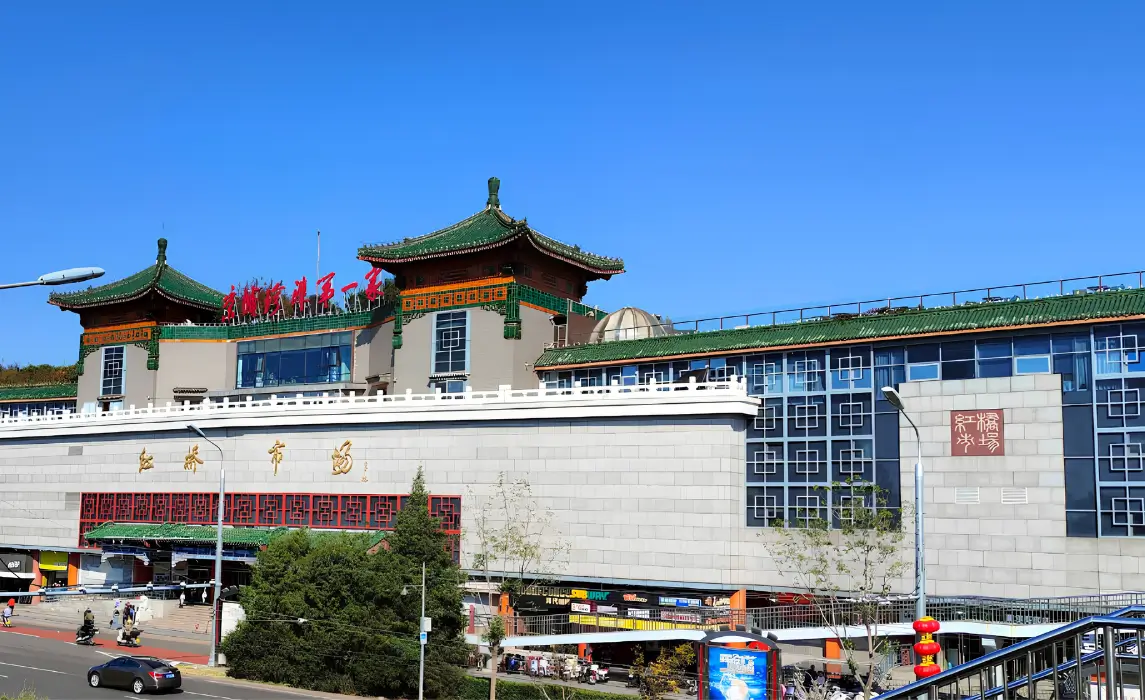
Hongqiao Pearl Market (红桥珍珠城)
Hongqiao sits directly across from the East Gate of the Temple of Heaven, which makes pairing the two in a single afternoon the most natural itinerary in this part of the city. The building runs eight floors, and its layout matters: the ground floor handles seafood and groceries for the local neighborhood. The first and second floors carry electronics, bags, accessories, and watches, bargaining here is aggressive and quality varies widely, so inspect everything carefully. The third floor is where the pearls are, and it's the reason over a million visitors come annually. Hongqiao is widely cited as the largest pearl distribution center in China, and the selection reflects that: freshwater pearl strands start at ¥50–200 (~$7–$28), while saltwater pearls, coral, and precious stone pieces extend into tens of thousands of yuan.
If you're buying pearls with any seriousness, come with basic knowledge: check luster (should be sharp and reflective, not milky), surface texture (fewer blemishes = higher grade), and nacre thickness (thicker = more durable). Many vendors here display fixed-price placards on certain items, which signals a more retail-oriented approach, still negotiable, but less dramatically than the floors below. The fourth and fifth floors carry silk clothing, embroidered table linens, jade, and tea, often at better prices than the tourist-heavy markets near Wangfujing. A silk scarf that runs ¥150 (~$21) near the Snack Street typically goes for ¥80–100 (~$11–$14) here with modest negotiation.
One detail that most guides skip: Margaret Thatcher reportedly visited this market three times specifically for the pearls, a small but telling indicator of what Hongqiao is actually known for among those who know Beijing well.
Get there: Metro Line 5 to Tiantan Dongmen, Exit B. Open daily 9am–7pm.
Read Related Article: Best Things to Buy in Malaysia: Malaysian Souvenirs and Must-Buy Items
Discover the best things to buy in Malaysia, from traditional handicrafts and local snacks to batik textiles and unique souvenirs. Find authentic Malaysian gifts and must-buy items to bring home from your trip.
Read More
What to Buy in Beijing
Tea
Beijing's historic tea brand is Wuyutai (吴裕泰), established in 1887 and still operating on Qianmen Street. Their jasmine tea is what old Beijingers drink at home. Loose-leaf jasmine starts around ¥50–150 (~$7–$21) per 100g; gift tins run ¥80–300 (~$11–$41). Zhang Yiyuan is the other trusted name, both are available at Wangfujing and Qianmen. Tea is lightweight, airport-friendly, and one of the most culturally honest things you can bring home from Beijing.
Silk and Cashmere
Silk scarves from Ruifuxiang on Qianmen are the benchmark, prices start at ¥200–600 (~$28–$83) for a proper hand-stitched piece. At Silk Street or Hongqiao, expect ¥80–200 (~$11–$28) for scarves after bargaining, though quality varies and the burn test (a small edge burns like hair, not plastic) remains the most reliable field check. Cashmere is a genuine Beijing buy, Inner Mongolia production means quality is high and prices are low compared to Western retail. A 100% cashmere scarf at a department store runs ¥300–800 (~$41–$110); at markets, budget ¥150–400 (~$21–$55) after negotiation.
Traditional Crafts
Cloisonné (enamel metalwork) is Beijing's signature craft and has been produced here since the Yuan Dynasty. Small decorative pieces start at ¥80–200 (~$11–$28); quality pieces from dedicated craft stores run higher. Cloth shoes from Neiliansheng on Qianmen (¥200–600 / ~$28–$83) are both functional and historically meaningful, the construction method hasn't changed since the Qing court. Paper-cut art, carved walnut bead bracelets, and hand-painted ceramic figurines (the clay "Rabbit God," a Beijing-specific folk icon) all make compact, lightweight gifts in the ¥30–150 (~$4–$21) range.
Domestic Sportswear
Li-Ning and Anta flagship stores are worth a visit specifically because they carry collections not exported internationally, and prices are significantly lower than what resellers charge abroad. A Li-Ning lifestyle sneaker runs ¥399–799 (~$55–$110); technical running shoes ¥599–1,299 (~$83–$179). Both brands have elevated their design language considerably in the past five years and are worn by locals as genuine style choices, not novelty buys.
Chinese Skincare
Domestic brands like Florasis (花西子) and Perfect Diary are 30–40% cheaper in Beijing than via international platforms. Florasis is particularly known for its embossed compact packaging, their pressed powder compacts run ¥148–298 (~$20–$41) locally. Pechoin (百雀羚), the heritage skincare brand dating to 1931, sells affordable face creams and serums at pharmacies and department stores for ¥30–80 (~$4–$11), genuinely good value and easy to pack.
Palace Museum Cultural Goods (故宫文创)
The Palace Museum's cultural product line has become one of the most talked-about souvenir categories in China over the past decade. Silk scarves featuring imperial paintings start at ¥168 (~$23), ceramic tea sets at ¥200–500 (~$28–$69), and the ornamental cat figurines based on the Forbidden City's resident cats are a perennial favourite. These are available at the museum itself and at the dedicated Palace Museum cultural stores inside several Beijing malls, a more meaningful purchase than generic tourist goods, and increasingly collectible.
Bargaining Tips
Bargaining is part of the transaction at all of Beijing's open markets, Panjiayuan, Silk Street, and Hongqiao, and at street vendors and smaller independent stalls. It is not appropriate at department stores, mall brand stores, or any business with a printed price tag. Knowing which context you're in before you start will save you embarrassment on both ends.
Start at 25–40% of the asking price. If a vendor quotes ¥800 for a jacket, open at ¥200–250. This is not offensive, it's expected. Vendors build negotiation room into the first quote as standard practice, and the gap between opening ask and fair value is often 60–70%.
Use silence. After you make your counteroffer, stop talking. Silence creates pressure in the seller's direction. Filling the gap with justification weakens your position. Let them respond.
Walk away slowly. If the price doesn't move to where you want it, turn and start leaving. In the majority of cases at Beijing markets, the vendor will call you back with a better number. This works most reliably when the stalls are dense and the vendor knows you have other options nearby.
Bundle for better terms. Buying two or three items from the same vendor gives you legitimate leverage to ask for a discount on the total. "If I take all three, what's the best price?" is a straightforward and effective ask.
Don't accept the second price either. The second price is usually still not the bottom. A confident market shopper typically goes through three to four rounds before landing at a fair number.
Know your floor. Before entering a market, have a rough sense of what things are worth, a quick search the night before goes a long way. Vendors can read immediately whether someone knows value, and that knowledge changes the entire dynamic of the negotiation.
Don't bargain if you're not buying. If you ask for a final price and the vendor meets it, follow through. Walking away after they've committed is bad form in any market culture and makes the whole experience worse for everyone.
Read Related Article: Best Souvenirs from Estonia: Things to Buy and Where to Find Them
Discover the best souvenirs from Estonia, including handcrafted goods, local foods, traditional textiles, and unique gifts. Learn what to buy and where to find authentic Estonian treasures during your visit.
Read More
FAQs
What is the best market in Beijing for antiques?
Panjiayuan is the largest and most varied, but go in knowing that most "antiques" are reproduction pieces. If you want something genuinely old, bring knowledge or a trusted Chinese-speaking contact. For purely decorative and souvenir-quality crafts, Panjiayuan offers the best selection and the most room to negotiate in the city.
Can tourists use WeChat Pay or Alipay?
International visitors can now link a foreign Visa or Mastercard to WeChat Pay via a tourist payment option introduced in 2023, but it's not universally reliable. The safest approach is to carry ¥500–1,000 (~$69–$138) in cash before heading to any market. ATMs inside malls reliably accept international cards; typical fee is ¥20–30 (~$3–$4) per withdrawal.
What should I avoid buying in Beijing?
Be cautious about "genuine antiques" at markets without authentication certificates, most are reproductions. Avoid electronics from unmarked market vendors unless you can verify return policies. Pearls below ¥50 (~$7) for a full strand are almost certainly synthetic rather than cultured. And the exotic street snacks (scorpions, starfish) near Wangfujing are priced as tourist experiences, not as food, ¥35–60 (~$5–$8) is a lot for something you'll take one bite of.
Prices current as of 2025–2026. Exchange rate used: approximately ¥7.25 per USD.
{ "@context": "https://schema.org", "@type": "Article", "mainEntityOfPage": { "@type": "WebPage", "@id": "https://example.com/beijing-shopping-guide" }, "headline": "Beijing Shopping Guide: Best Places to Shop", "image": [ "https://example.com/images/beijing-shopping-main.jpg", "https://example.com/images/wangfujing-street.jpg", "https://example.com/images/sanlitun-taikooli.jpg", "https://example.com/images/qianmen-street.jpg" ], "datePublished": "2024-01-01T09:00:00+08:00", "dateModified": "2024-01-01T09:00:00+08:00", "author": { "@type": "Person", "name": "Beijing Tourist Board" }, "publisher": { "@type": "Organization", "name": "Beijing Travel Guide", "logo": { "@type": "ImageObject", "url": "https://example.com/images/publisher-logo.png" } }, "description": "Your Beijing Shopping Guide: Find the best places to shop, from luxury shopping malls to bustling shopping streets for unique finds and great bargains.", "articleBody": "Beijing doesn't do shopping in half measures. Within a single afternoon, you can bargain down a silk scarf at a centuries-old market, browse a luxury department store that outsells Harrods on annual revenue, then grab skewered street food on your way to the metro. Every neighborhood has its own tier of retail, and knowing which area serves which purpose will save you real time, and real money.\n\nThis guide focuses on the three shopping districts that matter most, the three markets worth your morning, what to actually put in your bag, and how to bargain without getting taken.\n\nShopping Districts\nWangfujing (王府井)\n\nWangfujing is Beijing's most famous shopping street, and it earns that title more through history and infrastructure than any single standout experience. The name translates to \"Well of the Prince's Mansion,\" a nod to the Ming Dynasty estates that once lined this stretch of Dongcheng District. Today it's a fully pedestrianized corridor running roughly 800 meters, no cars, no bikes, and on a weekend evening, barely room to breathe.\n\nWhat makes it genuinely useful is the variety packed into a walkable strip. The Beijing Department Store (百货大楼), open since 1955, anchors the south end with silk scarves (¥80–200 / ~$11–$28), tea sets, and cloisonné ware at prices that don't require bargaining. The Beijing APM Mall carries the only three-story Apple Store in Asia alongside K-beauty counters and international fast fashion. For higher-end brands, Gucci, Saint Laurent, WF Central sits tucked behind quiet courtyard architecture nearby, designed deliberately to slow you down from the main street's pace.\n\nThe Snack Street (王府井小吃街) branching off the main strip is the most photographed part: vendors selling Peking yogurt, lamb skewers, and the scorpion-on-a-stick that every travel photo features. Most snacks run ¥10–35 ($1.40–$5). The scorpions are alive until cooked, it's a tourist novelty, not a traditional Beijing food, so go in with that framing. For a real meal, Quanjude on Wangfujing has served roast duck since 1864; budget ¥150–250 ($21–$35) per person. One honest note: Wangfujing can feel caught between worlds, it's lost some historical character without fully matching the modern edge of Sanlitun or Guomao. It's worth visiting, especially at night when the neon hits the old facades, but it shouldn't be your only stop.\n\nGet there: Metro Line 1 or 8 to Wangfujing Station. Weekday mornings are noticeably calmer.\n\nSanlitun (三里屯)\n\nIf Wangfujing is Beijing's most recognized shopping street, Sanlitun is where Beijing actually wants to be seen. Originally the embassy quarter and nightlife hub, it has evolved over two decades into the most internationally charged district in the capital, a place where expats, local fashion editors, and first-time tourists all occupy the same open-air plaza without any one group dominating it.\n\nThe heart of the district is Sanlitun Taikoo Li (太古里), an open-air complex of glass-and-stone that splits into a north and south section. The Apple Store here was Asia-Pacific's largest when it opened in 2020. Beyond that, you'll find Nike flagship, Adidas, Lululemon, Uniqlo's biggest Beijing outpost, and enough emerging Chinese streetwear labels, Bosie, SMFK, Attempt, to fill a full afternoon if that's your direction. Prices in branded stores are fixed and globally comparable: Nike Air Max runs ¥1,099–1,599 (~$152–$221), Uniqlo basics ¥99–299 (~$14–$41). The north section of Taikoo Li runs quieter and more curated, worth exploring once the south section crowd gets overwhelming.\n\nWhat sets Sanlitun apart from every other district is that it functions as much as a leisure destination as a retail one. Terraces fill up by early evening, bars activate after 8pm, and the mood shifts meaningfully between a Sunday afternoon browse and a Thursday night out. The Sanlitun SOHO complex across the road hosts an \"I'm in Beijing\" photo landmark that's become a genuine local institution. The crowd here skews younger and more fashion-forward than Guomao, and the energy is more international than Xidan, it's the district that makes the best argument for Beijing as a genuinely global shopping city.\n\nGet there: Metro Line 10 to Tuanjiehu, Exit A.\n\nQianmen Street (前门大街)\n\nQianmen is one of the rare shopping areas that actually lives up to its historical framing. Running from the grand Zhengyang Gate southward along the city's central axis, this was once the imperial ceremonial route, and unlike Wangfujing, which shed most of its historical character in the push toward modernity, Qianmen retained the grey brick façades and Ming-Qing dynasty architectural silhouette even as the interiors were rebuilt.\n\nWalking it today, you'll find the kind of mix that's increasingly hard to find in Beijing: established Chinese heritage brands operating exactly where they always have. Neiliansheng (内联升), the cloth shoe maker that has been on this street since 1853, still sells hand-stitched shoes using the same construction method used for the Qing court, prices start at ¥200–600 (~$28–$83) depending on design. Ruifuxiang (瑞蚨祥) has supplied silk to Chinese families since the 1890s; a bolt of fabric or a silk qipao here is one of the more meaningful purchases you can make in the city. Wuyutai (吴裕泰), the jasmine tea brand that old Beijingers consider simply part of daily life, has a flagship here where loose leaf starts around ¥50–300 (~$7–$41) per 100g. These are not tourist approximations of old Beijing culture; they are old Beijing culture, still operating.\n\nThe Dashilan alley (大栅栏, pronounced \"Dashilar\") branches west off the main street into a more chaotic, more local stretch of narrow storefronts and hutong lanes worth exploring on foot. Qianmen's best quality, though, is the evening. When the traditional buildings light up, the atmosphere becomes genuinely cinematic, families walking, street performers along the edges, the pace dropping compared to the daytime tourist flow. It's worth coming back after dinner specifically for this.\n\nGet there: Metro Line 2 or 8 to Qianmen Station. Most shops open 9am–9pm.\n\nMarkets\nPanjiayuan Antique Market (潘家园旧货市场)\n\nPanjiayuan is the largest secondhand and antiques market in China, 48,500 square meters across Chaoyang District's southeast corner, and it runs on a weekend logic that regular markets don't. On weekdays, the permanent shops are open 8:30am–6pm. But the full market only activates on weekends, when several thousand open-air stalls arrive as early as 4:30am. Coming Saturday morning before 9am means watching dealers buy from dealers, which is as close as you'll get to seeing how the pricing actually works before the tourist markup kicks in.\n\nGenuine antiques exist but require real knowledge, most items sold as antique were made recently, and that's fine as long as you're not paying antique prices for them. Where Panjiayuan excels is in the breadth of well-priced crafts and collectibles that don't pretend to be ancient: hand-painted ceramics (¥30–200 / ~$4–$28), calligraphy scrolls, Cultural Revolution-era enamel pins, cloisonné trinkets, carved walnut bead bracelets, vintage propaganda posters, and old military badges. The northeast corner houses jade and gemstone vendors ranging from low-cost bead strings to higher-end Hetian jade, authentication is your responsibility, so either bring knowledge or stick to decorative pieces. There's also a dedicated section for old books, maps, and illustrated manuscripts, surprisingly rich if you can read Chinese.\n\nBargaining is expected at every stall. Start at 40–50% of the asking price and settle around 60–70%. Vendors here are experienced and won't be offended, the initial ask already accounts for the negotiation. One practical note: Panjiayuan rewards patience. The best finds are in the outer stalls and the folding-table sections that set up on weekend mornings, not in the permanent indoor shops.\n\nGet there: Metro Line 10 to Panjiayuan Station. Open daily; weekends are the main event.\n\nSilk Street Market / Xiushui Market (秀水街)\n\nSilk Street is one of Beijing's most internationally recognized markets, now housed in a six-floor indoor building near Guomao rather than the open-air chaos it once was. The knockoff reputation hasn't fully disappeared, but the market has shifted visibly over the past decade, the lower floors are where the most theatrical bargaining happens, while the mid-floors carry genuinely worthwhile goods: authentic silk products, traditional crafts, and custom-made Chinese clothing that are worth your time.\n\nKnowing the floors before you go in saves real confusion. The first and second floors carry clothing, sportswear, and the most aggressively priced goods, vendors quote ¥800–950 (~$110–$131) for things worth ¥200–250 (~$28–$34), and countering at 25–30% of the asking price is completely standard. Floors three through five shift toward handcrafts, tailored clothing, and souvenir goods where pricing is less theatrical and quality more consistent. The fourth floor's handicraft section, porcelain, snuff bottles, carved fans, lacquerware, cloisonné, is one of the better concentrated souvenir stops in the city if you skip the lower-floor noise entirely.\n\nThe tailors on the third floor are a genuine reason to visit. A fitted qipao can be completed in 24–48 hours for ¥300–800 (~$41–$110) depending on fabric and embroidery; bring a reference photo and your measurements. The tailors here work with foreign tourists constantly, communicate in functional English, and deliver fast. It's not couture, but it's a memorable and useful purchase. Open daily 9:30am–9pm.\n\nGet there: Metro Line 1 to Yong'anli, Exit A.\n\nHongqiao Pearl Market (红桥珍珠城)\n\nHongqiao sits directly across from the East Gate of the Temple of Heaven, which makes pairing the two in a single afternoon the most natural itinerary in this part of the city. The building runs eight floors, and its layout matters: the ground floor handles seafood and groceries for the local neighborhood. The first and second floors carry electronics, bags, accessories, and watches, bargaining here is aggressive and quality varies widely, so inspect everything carefully. The third floor is where the pearls are, and it's the reason over a million visitors come annually. Hongqiao is widely cited as the largest pearl distribution center in China, and the selection reflects that: freshwater pearl strands start at ¥50–200 (~$7–$28), while saltwater pearls, coral, and precious stone pieces extend into tens of thousands of yuan.\n\nIf you're buying pearls with any seriousness, come with basic knowledge: check luster (should be sharp and reflective, not milky), surface texture (fewer blemishes = higher grade), and nacre thickness (thicker = more durable). Many vendors here display fixed-price placards on certain items, which signals a more retail-oriented approach, still negotiable, but less dramatically than the floors below. The fourth and fifth floors carry silk clothing, embroidered table linens, jade, and tea, often at better prices than the tourist-heavy markets near Wangfujing. A silk scarf that runs ¥150 (~$21) near the Snack Street typically goes for ¥80–100 (~$11–$14) here with modest negotiation.\n\nOne detail that most guides skip: Margaret Thatcher reportedly visited this market three times specifically for the pearls, a small but telling indicator of what Hongqiao is actually known for among those who know Beijing well.\n\nGet there: Metro Line 5 to Tiantan Dongmen, Exit B. Open daily 9am–7pm.\n\nWhat to Buy in Beijing\nTea\n\nBeijing's historic tea brand is Wuyutai (吴裕泰), established in 1887 and still operating on Qianmen Street. Their jasmine tea is what old Beijingers drink at home. Loose-leaf jasmine starts around ¥50–150 (~$7–$21) per 100g; gift tins run ¥80–300 (~$11–$41). Zhang Yiyuan is the other trusted name, both are available at Wangfujing and Qianmen. Tea is lightweight, airport-friendly, and one of the most culturally honest things you can bring home from Beijing.\n\nSilk and Cashmere\n\nSilk scarves from Ruifuxiang on Qianmen are the benchmark, prices start at ¥200–600 (~$28–$83) for a proper hand-stitched piece. At Silk Street or Hongqiao, expect ¥80–200 (~$11–~$28) for scarves after bargaining, though quality varies and the burn test (a small edge burns like hair, not plastic) remains the most reliable field check. Cashmere is a genuine Beijing buy, Inner Mongolia production means quality is high and prices are low compared to Western retail. A 100% cashmere scarf at a department store runs ¥300–800 (~$41–$110); at markets, budget ¥150–400 (~$21–$55) after negotiation.\n\nTraditional Crafts\n\nCloisonné (enamel metalwork) is Beijing's signature craft and has been produced here since the Yuan Dynasty. Small decorative pieces start at ¥80–200 (~$11–$28); quality pieces from dedicated craft stores run higher. Cloth shoes from Neiliansheng on Qianmen (¥200–600 / ~$28–$83) are both functional and historically meaningful, the construction method hasn't changed since the Qing court. Paper-cut art, carved walnut bead bracelets, and hand-painted ceramic figurines (the clay \"Rabbit God,\" a Beijing-specific folk icon) all make compact, lightweight gifts in the ¥30–150 (~$4–$21) range.\n\nDomestic Sportswear\n\nLi-Ning and Anta flagship stores are worth a visit specifically because they carry collections not exported internationally, and prices are significantly lower than what resellers charge abroad. A Li-Ning lifestyle sneaker runs ¥399–799 (~$55–$110); technical running shoes ¥599–1,299 (~$83–$179). Both brands have elevated their design language considerably in the past five years and are worn by locals as genuine style choices, not novelty buys.\n\nChinese Skincare\n\nDomestic brands like Florasis (花西子) and Perfect Diary are 30–40% cheaper in Beijing than via international platforms. Florasis is particularly known for its embossed compact packaging, their pressed powder compacts run ¥148–298 (~$20–$41) locally. Pechoin (百雀羚), the heritage skincare brand dating to 1931, sells affordable face creams and serums at pharmacies and department stores for ¥30–80 (~$4–$11), genuinely good value and easy to pack.\n\nPalace Museum Cultural Goods (故宫文创)\n\nThe Palace Museum's cultural product line has become one of the most talked-about souvenir categories in China over the past decade. Silk scarves featuring imperial paintings start at ¥168 (~$23), ceramic tea sets at ¥200–500 (~$28–$69), and the ornamental cat figurines based on the Forbidden City's resident cats are a perennial favourite. These are available at the museum itself and at the dedicated Palace Museum cultural stores inside several Beijing malls, a more meaningful purchase than generic tourist goods, and increasingly collectible.\n\nBargaining Tips\n\nBargaining is part of the transaction at all of Beijing's open markets, Panjiayuan, Silk Street, and Hongqiao, and at street vendors and smaller independent stalls. It is not appropriate at department stores, mall brand stores, or any business with a printed price tag. Knowing which context you're in before you start will save you embarrassment on both ends.\n\nStart at 25–40% of the asking price. If a vendor quotes ¥800 for a jacket, open at ¥200–250. This is not offensive, it's expected. Vendors build negotiation room into the first quote as standard practice, and the gap between opening ask and fair value is often 60–70%.\n\nUse silence. After you make your counteroffer, stop talking. Silence creates pressure in the seller's direction. Filling the gap with justification weakens your position. Let them respond.\n\nWalk away slowly. If the price doesn't move to where you want it, turn and start leaving. In the majority of cases at Beijing markets, the vendor will call you back with a better number. This works most reliably when the stalls are dense and the vendor knows you have other options nearby.\n\nBundle for better terms. Buying two or three items from the same vendor gives you legitimate leverage to ask for a discount on the total. \"If I take all three, what's the best price?\" is a straightforward and effective ask.\n\nDon't accept the second price either. The second price is usually still not the bottom. A confident market shopper typically goes through three to four rounds before landing at a fair number.\n\nKnow your floor. Before entering a market, have a rough sense of what things are worth, a quick search the night before goes a long way. Vendors can read immediately whether someone knows value, and that knowledge changes the entire dynamic of the negotiation.\n\nDon't bargain if you're not buying. If you ask for a final price and the vendor meets it, follow through. Walking away after they've committed is bad form in any market culture and makes the whole experience worse for everyone.\n\nFAQs\nWhat is the best market in Beijing for antiques?\n\nPanjiayuan is the largest and most varied, but go in knowing that most \"antiques\" are reproduction pieces. If you want something genuinely old, bring knowledge or a trusted Chinese-speaking contact. For purely decorative and souvenir-quality crafts, Panjiayuan offers the best selection and the most room to negotiate in the city.\n\nCan tourists use WeChat Pay or Alipay?\n\nInternational visitors can now link a foreign Visa or Mastercard to WeChat Pay via a tourist payment option introduced in 2023, but it's not universally reliable. The safest approach is to carry ¥500–1,000 (~$69–$138) in cash before heading to any market. ATMs inside malls reliably accept international cards; typical fee is ¥20–30 (~$3–$4) per withdrawal.\n\nWhat should I avoid buying in Beijing?\n\nBe cautious about \"genuine antiques\" at markets without authentication certificates, most are reproductions. Avoid electronics from unmarked market vendors unless you can verify return policies. Pearls below ¥50 (~$7) for a full strand are almost certainly synthetic rather than cultured. And the exotic street snacks (scorpions, starfish) near Wangfujing are priced as tourist experiences, not as food, ¥35–60 (~$5–$8) is a lot for something you'll take one bite of.\n\nPrices current as of 2025–2026. Exchange rate used: approximately ¥7.25 per USD." }

.webp)
.webp)
.webp)
.webp)
%2520(1).webp)
.webp)
.webp)
.webp)
.webp)
.webp)
.webp)
.webp)
.webp)
.webp)
.webp)
.webp)
.webp)
.webp)
.webp)
.webp)
.webp)
.webp)
.webp)
.webp)
.webp)
.webp)
.webp)
.webp)
.webp)
.webp)
.webp)